
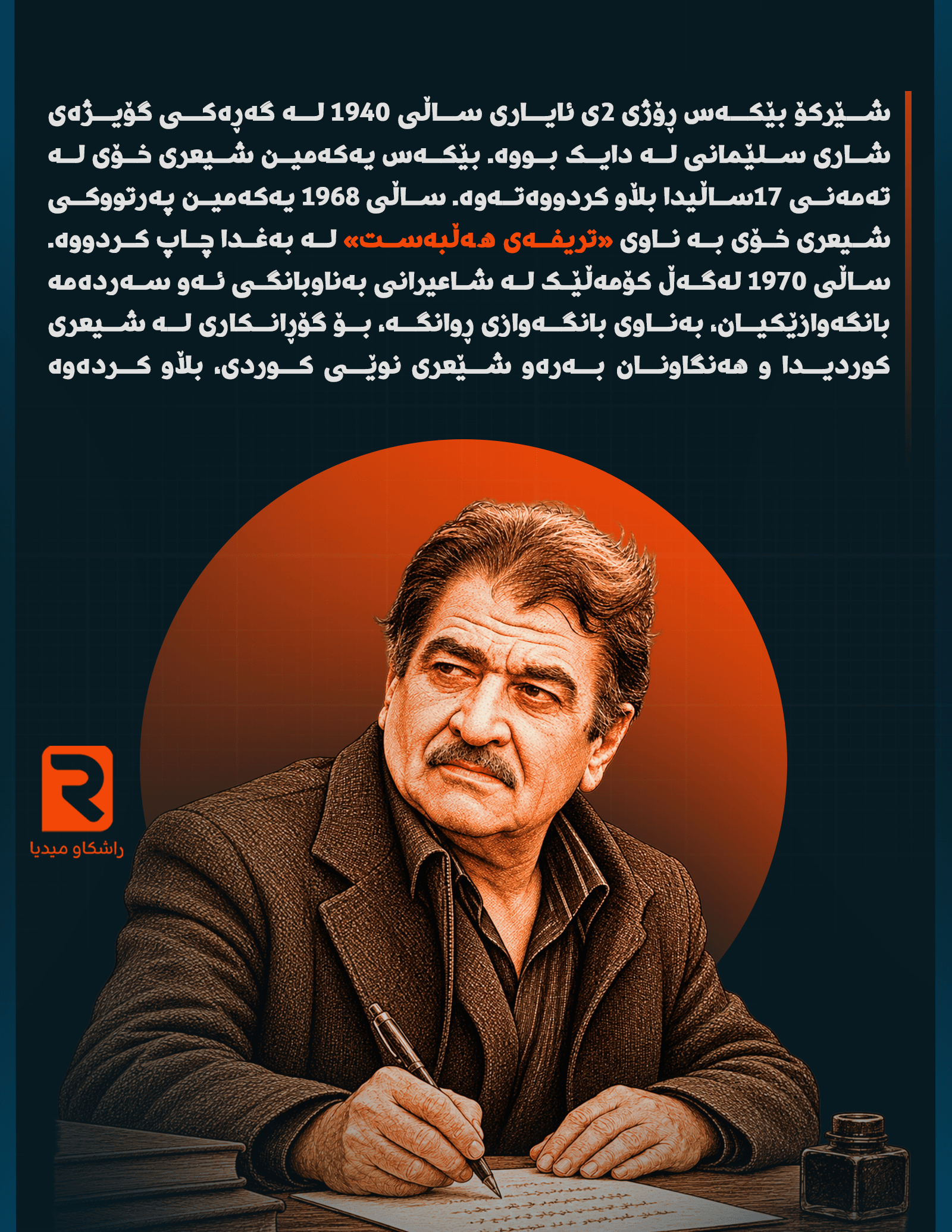
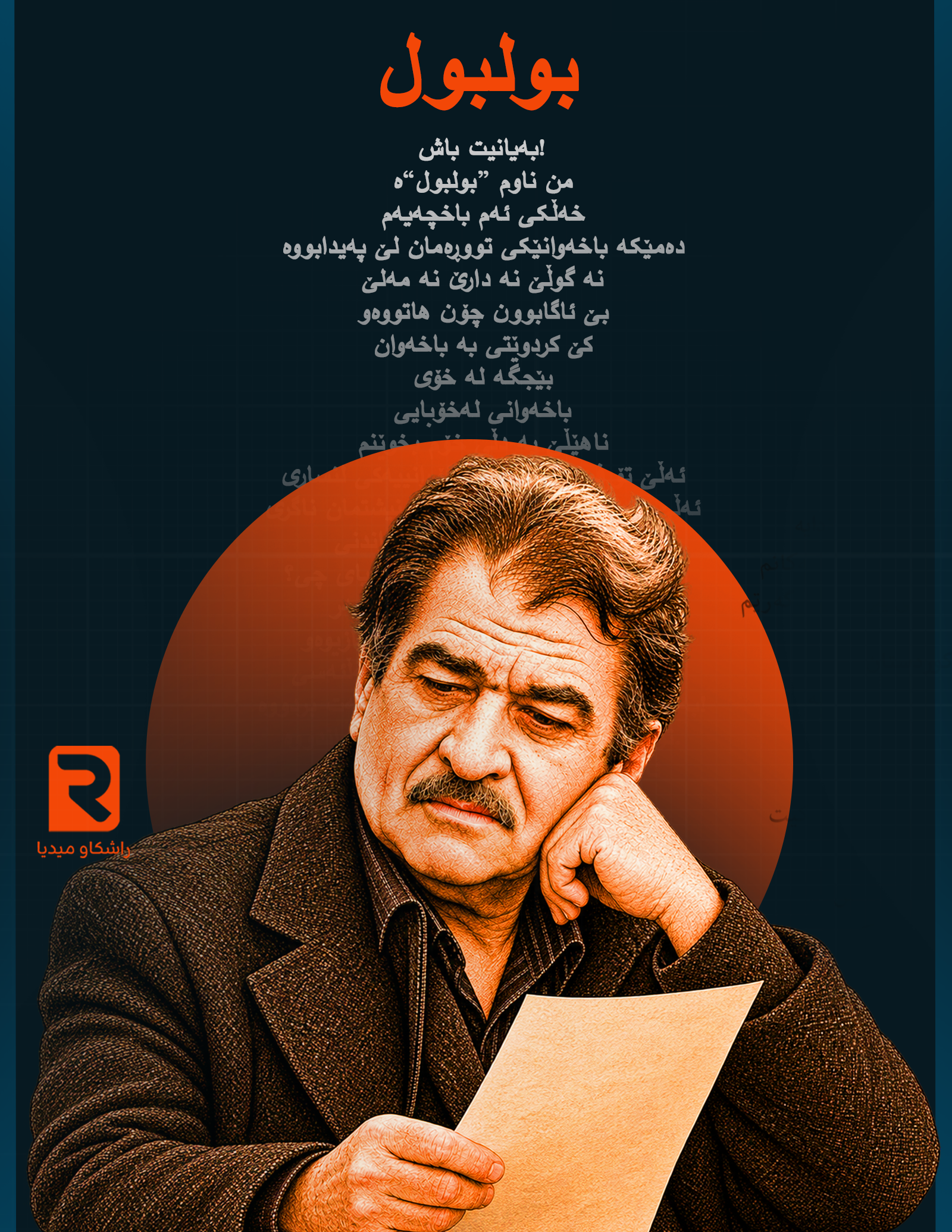
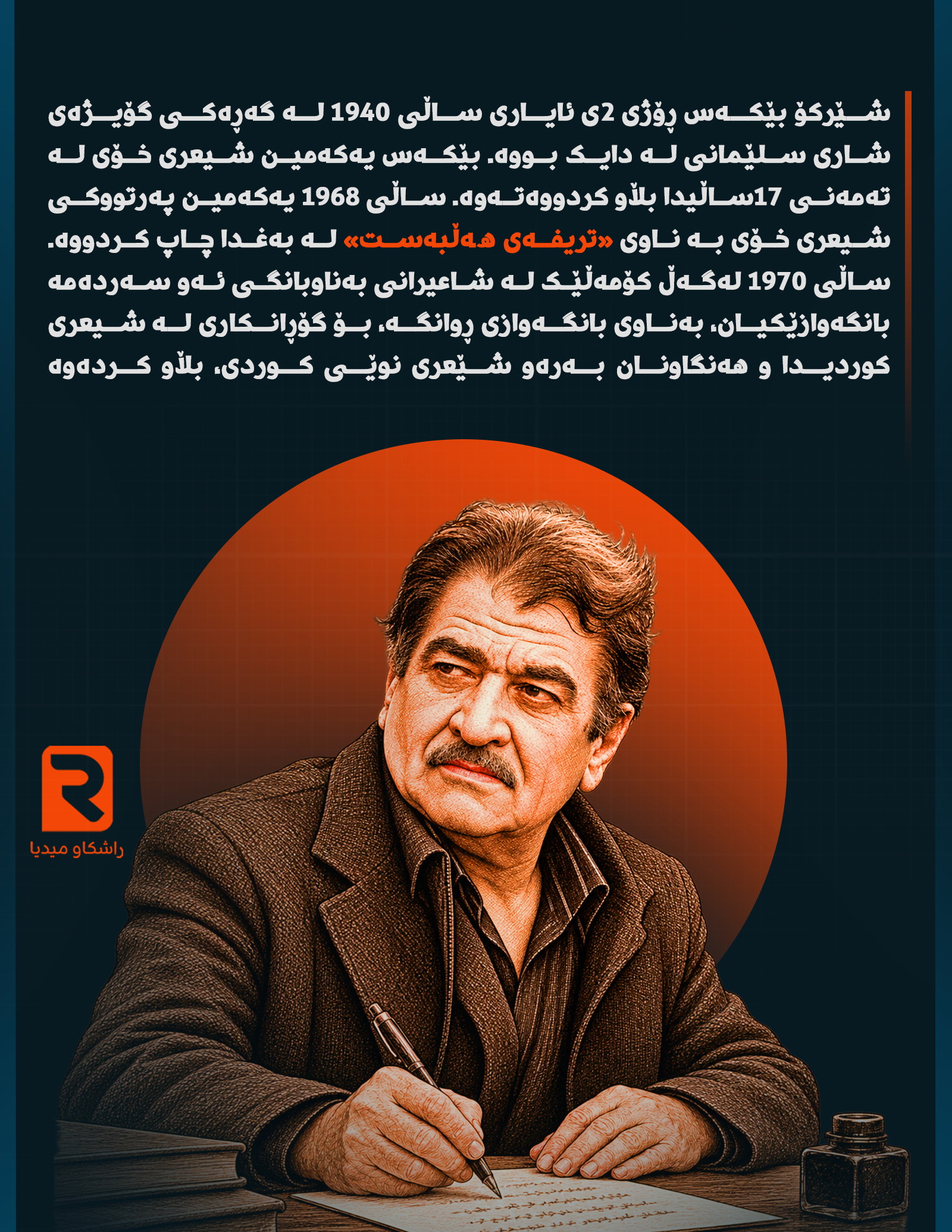
Sherko Bekas (1940-2013), is one of the greatest and most influential contemporary modernist Kurdish poets, who sparked a major revolution in Kurdish poetry with his sharp pen and creative style. He is the son of the prominent patriotic Kurdish poet, Fayaq Bekas, and was born on May 2, 1940, in the Goyzha neighborhood of Sulaymaniyah. Growing up in a literary and patriotic family had a profound impact on the formation of his poetic personality and national sentiment.
In the 1970s, Sherko Bekas, along with several other writers and poets, published the "Ruwanga" (Vision) manifesto, which aimed to modernize Kurdish literature and language and break away from traditional molds. Due to his national stances and patriotic poetry, he faced pressure and persecution by the Ba'ath regime and later joined the ranks of the Peshmerga, where his poems, broadcasted through the "Voice of the Mountain" radio, became a catalyst for the people's revolutionary spirit.
Due to the difficult circumstances, in 1986 he was forced to leave Iraq and Kurdistan and head abroad. From 1987 to 1992, he resided in Sweden. During this phase, Sherko's poetic voice crossed borders and reached a global level; many of his poems were translated into several living languages of the world (such as English, French, German, Swedish, Arabic, and Turkish). In recognition of his humanitarian and freedom-loving poetry, he was awarded the "Tucholsky Prize" in Sweden in 1987, a major international award presented directly by the Swedish Prime Minister of the time, Ingvar Carlsson.
After the spring uprising of 1991, Sherko returned to the embrace of the homeland. In 1992, in the first cabinet of the Kurdistan Regional Government, he was chosen as the first Minister of Culture and contributed greatly to the field. His cultural endeavors continued, and in 1998, with the help of a group of writers and intellectual friends, he founded the "Sardam Publishing House", which remains one of the most important publishing centers in Kurdistan.
Sherko Bekas is the author of dozens of booklets, poetry collections, and long poetic epics (such as: The Valley of Butterflies, The Cemetery of Lanterns, The Cross and the Snake, Diary of a Poet, and Now a Girl is My Homeland). His poems are a mirror reflecting the suffering of his nation, the Halabja and Anfal tragedies, the nature of Kurdistan, women's issues, and love. In 2009, he published his complete works in nearly eight thousand pages.
Ultimately, after a lifetime of creativity and service, he passed away on August 4, 2013, in a hospital in Stockholm, the capital of Sweden, due to cancer. According to his will, his body was returned to Kurdistan and buried in "Azadi Park" in the city of Sulaymaniyah, so that, as he wished, he would always remain close to the people and listen to music and the footsteps of lovers.
Comments
No comments yet.